VECTORS!
vectors are quantities that have magnitude (length) and direction (orientation)
| WHAT CAN VECTORS REPRESENT? |
|---|
| vectors can represent displacement, velocity, force, or acceleration |
| SOH | CAH | TOA |
|---|---|---|
| sin: opposite/hypotenuse | cos: adjacent/hypotenuse | tan: opposite/adjacent |
DRAWING &
NAMING VECTORS
using the +/-
axis methods
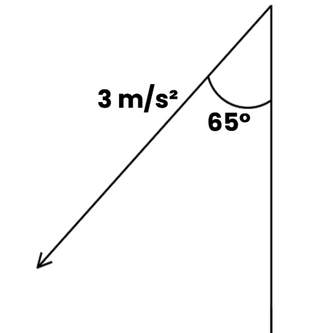
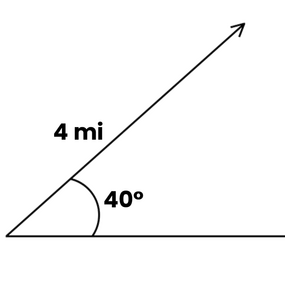
compass method : 3 m/s2,
65° west of south
+/- axis method : 4 mi, 40° above x-axis
VECTOR ADDITION
using the tip to tail method
1. choose a scale. in this problem, we will use 1 cm = 1 cm.
our given is :
vector A = 5 cm west (W)
vector B = 10 cm south (S)

2. lay down 1st vector A
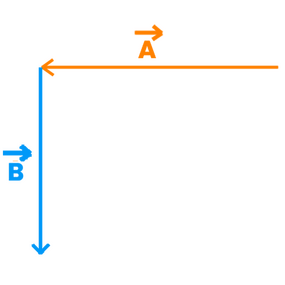
3. lay down vector B so the tail of B connects to the tip of vector A (tip: use a protractor to ensure a 90° angle is made)
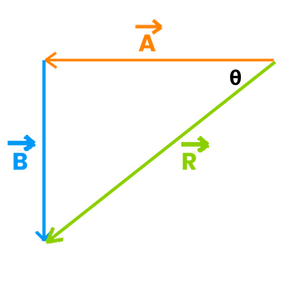
4. resultant vector (R) is created from tail of A to tip of B. measure the length of vector R and the angle (θ) created
5. measure the length of vector R and the angle (θ) created.
vector R = 11.2 cm at 63° S of W
COMPONENTS OF VECTORS
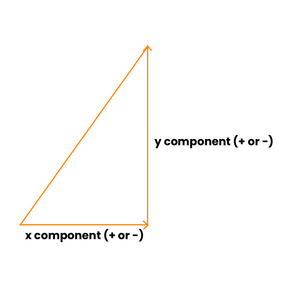
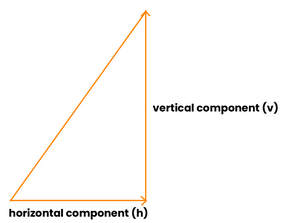
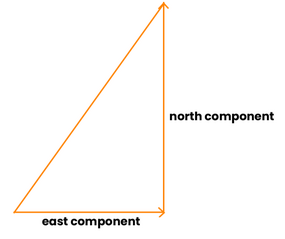
x or y comp.
horizontal or vertical comp.
compass points (N, S, E, W)
SAMPLE COMPONENTS PROBLEM
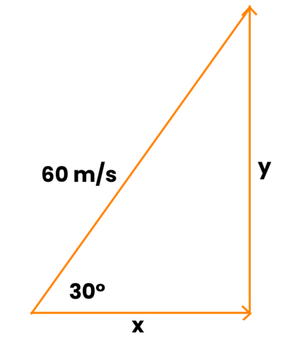
a ball is thrown at 60 m/s 30° from the x direction. what is the ball's velocity in the x and y direction?
cos (30) = x / 60
60 cos (30) = x
x = 51.96 m/ssin (30) = y / 60
60 sin (30) = y
y = 30 m/s